Tax Assessed Value vs List Price: What Investors Miss in Texas
Why Texas tax assessed value often differs from Zillow list price, how it affects property tax modeling in Realy, and what investors should verify before underwriting.
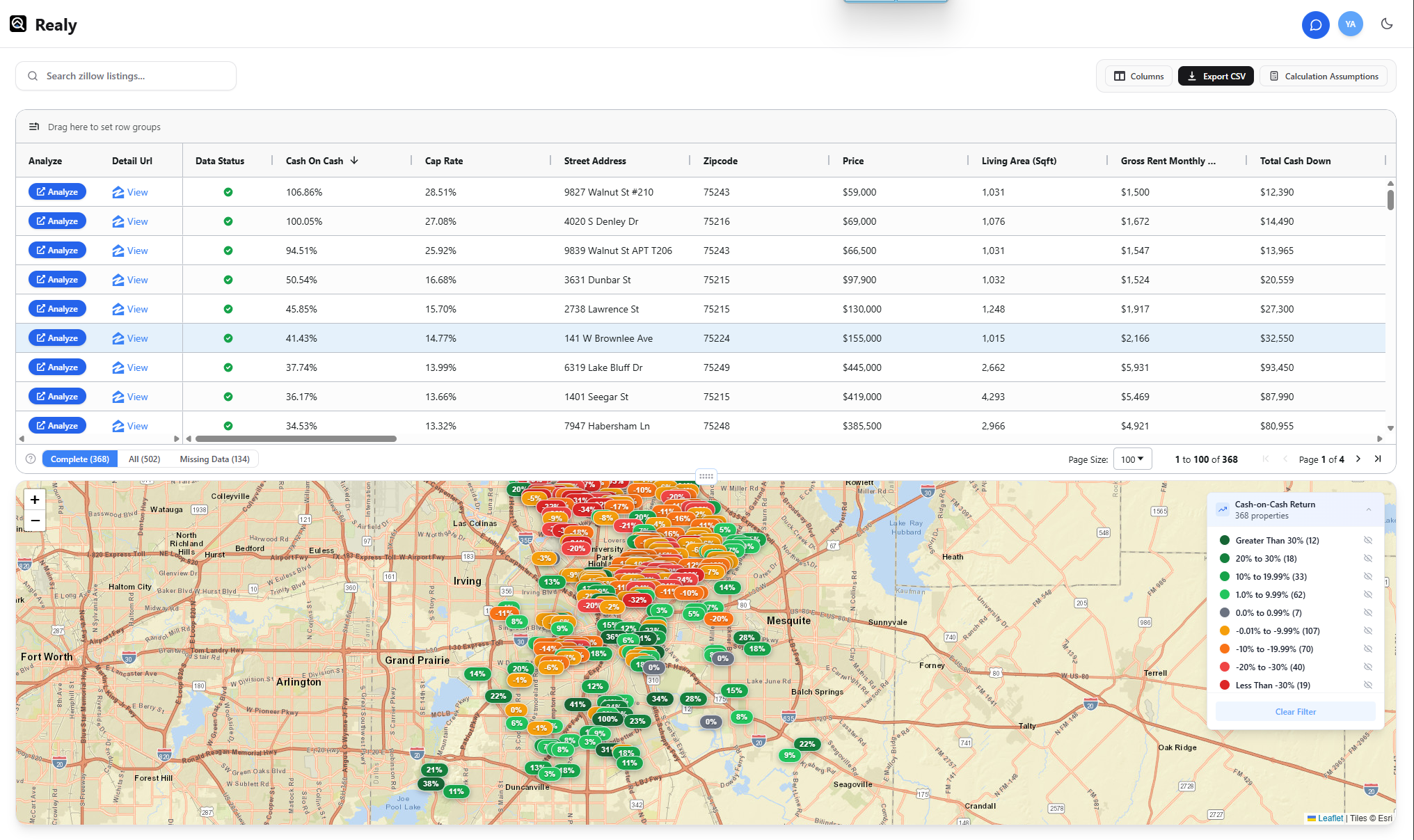
Texas investors love the cash-flow math, until the actual tax bill arrives. Tax assessed value on Zillow is not your annual tax bill, and it often bears little resemblance to list price. Model wrong, and your cap rate fiction becomes cash-flow reality.
Three Numbers Investors Confuse
| Term | What it is |
|---|---|
| List price | What seller wants today (Zillow) |
| Tax assessed value | County appraisal district value (Zillow shows this) |
| Annual tax bill | What you actually pay (county treasurer) |
Realy's default property tax model:
Property Taxes = Purchase Price × Tax Rate (default 2%)
When selectedOptions.propertyTaxes = "percentSaleValue" and taxRate = 0.02 (from 2.00% input).
That uses your purchase price, not assessed value, usually reasonable for screening if 2% matches local effective rates.
Texas Is Different
Texas has:
- No state income tax (property tax load is higher)
- County appraisal districts (CAD) setting assessed values
- Homestead exemptions (seller may have one, but you won't as investor)
- Reappraisal on sale in many counties (bill can jump after purchase)
- Proposition 13-style caps don't apply: annual increases can be meaningful
Result: Assessed value on Zillow may be above or below list price, and neither equals your post-purchase bill.
Real Examples from Dallas Listings
From Realy-analyzed Dallas inventory:
| Property | List price | Tax assessed (Zillow) | Gap |
|---|---|---|---|
| 9827 Walnut St #210 | $59,000 | $113,410 | Assessed 2× list |
| 4020 S Denley Dr | $69,000 | $176,940 | Assessed 2.6× list |
| 141 W Brownlee Ave | $155,000 | $194,320 | Assessed 1.25× list |
| 6319 Lake Bluff Dr | $445,000 | $401,520 | Assessed ~0.9× list |
If you assumed taxes = 2% of assessed value on Denley Dr:
$176,940 × 2% = $3,539/yr
If you buy at $69,000 and county eventually appraises toward market:
Future bill could be much higher after purchase
If you modeled 2% of list price:
$69,000 × 2% = $1,380/yr
That's a $2,159/yr swing, enough to flip a deal from cash-flow positive to negative.
What to Do Instead of Guessing
Step 1: Pull the current tax bill
Search: "[county name] appraisal district" + address
Dallas County → DCAD. Collin, Tarrant, Denton have separate CADs.
Step 2: Check exemption status
Homestead on seller's bill lowers current tax. Your investor bill will be higher.
Step 3: Estimate post-purchase appraised value
Many counties reassess toward purchase price. Underwriting tax at 2% of purchase price is a common screen; some investors use 2.2–2.5% buffer in Texas.
Step 4: Enter actual tax in Realy
Switch property taxes to $ Yearly Amount in assumptions with the real or projected bill.
How Assessed Value Still Helps on Zillow
| Signal | Interpretation |
|---|---|
| Assessed well above list | Possible tax upside risk after buy; verify bill |
| Assessed well below list | May indicate below-market buy, or assessment lag |
| Assessed ≈ list | Easier tax modeling (still verify) |
Cross-reference with red flags #3.
Impact on Realy Metrics
Higher taxes → lower NOI → lower cap rate and CoC:
NOI = Effective Gross Income − Operating Expenses
reTaxes is part of totalOperatingExpenses
capRate = netAnnualIncome / purchasePrice
A $2,000/yr tax underestimate costs ~$167/mo cash flow, $2,000/yr off your CoC numerator.
Texas Investor Tax Checklist
- Pull current tax bill from county CAD
- Remove homestead benefit mentally
- Estimate post-purchase appraised value
- Enter annual tax in Realy (not just 2% default)
- Re-run NOI and CoC
- Compare to Houston top 10 assumptions
Run Texas Deals with Real Tax Data
Install Realy → open Dallas Zillow search → customize tax line per property.
Related: When high cap rate is a trap · Out-of-state Texas investing
Found this useful?
Share it with an investor friend or teammate.